• + 39.02.57602651
  • info@proind.it
logo Proindlogo Proindlogo Proindlogo Proind
  • Company
  • Certifications
  • Product
    • Release agents and adjuvants
    • Waterproofing products
    • Anti-shrinkage cement mortars
    • Corrosion control products
    • Professional accessories for construction
    • Special technical products
  • Product guide
  • Applications on site
  • Blog
  • Contacts
0
English
  • Italian
Cemento armato
Disarming: essential solutions for efficient, high-quality construction
February 25, 2026
Centrale idroelettrica EDISON
Restoration of the diversion canal of the EDISON hydroelectric power plant in Paderno d’Adda
March 11, 2026

Consolidation and waterproofing of the walls of a historic building in Milan

Fregio palazzo Milano

Specialized interventions for the protection of historic walls

Many buildings located in central city areas suffer from the constant attack of external atmospheric agents, where the presence of pollutants aggravates the deterioration of natural stone elements. Poor maintenance of exterior walls, also exposed to the progressive passage of time, ultimately leads to visible deterioration that can even lead to the actual physical detachment of portions and/or elements. The fall of these portions, even from considerable heights, can cause physical accidents involving passers-by and possibly involving the building manager.

Consolidation, in its many and varied aspects, therefore responds to the fundamental need to re-stabilize the physical and mechanical conditions of a structure altered by degradation processes.

Consolidation and waterproofing solutions for the protection of historic buildings

Over time, a variety of events tend to cause alterations in the physical-mechanical properties of an object during the consolidation of the material. Thus, materials, procedures, and tools are used to improve the cohesion and adhesion between the constituents of a stone material, namely:

  • the elimination of abrupt discontinuities in the physical-mechanical characteristics between healthy and degraded material
  • the re-establishment of continuity in the “system profile” of healthy material + consolidated degraded material


To perform a consolidation, the following must be considered:

  • durability
  • compatibility
  • minimal intervention
  • the stability of the intervention over time
  • compatibility (with other materials and elements present)
  • the inertia of the materials and systems used with respect to the treated material and the environment to which it belongs
  • the retreatability of the area affected by the intervention with the same or different methods and products

How to intervene to consolidate damaged surfaces

Surface consolidation is a nearly permanent intervention that, at most, may lose its effectiveness after a reasonable period of time, but it should never cause damage.

Proind was also involved in this project due to its long-standing experience in the restoration sector. The focus was on:

  • consolidation of the stone sections (Sarnico stone) that make up the friezes and window surrounds
  • treatment of the walls with a suitable water repellent

Friezes below the eaves, moldings around the windows and horizontal decorative bands

The friezes in the section below the gutter area are the areas most at risk for serious accidents, and similar deterioration issues have been observed on the stones around the window frames, with evident flaking of the materials. Another example is the horizontal decorative bands, which present similar problems as the window moldings, with transverse flaking.

Fregio palazzo Milano

Permanent consolidation of surfaces with ethyl silicate

Their consolidation was effectively achieved using ETHYL SILICATE. The consolidant must impregnate the material until its degraded parts are joined to the still sound and solid parts, and must not excessively reduce the porosity of the material itself.

Ethyl silicate itself bases its consolidating effect not so much on the formation of amorphous silica through hydrolysis, but on the hydrogen bonds that form between the silica and the hydroxyl groups of the silicate stone.

Protection of absorbent building materials with water repellent

Once the consolidant was applied, a suitable water repellent such as HYDROSTOP was finally applied to the surfaces, protecting the previously treated stone sections.

HYDROSTOP is a liquid composed of a blend of special oligomeric organosiloxane formulations with hydrophobic and waterproofing properties, through impregnation, of absorbent building materials. It is particularly suitable for protecting absorbent building materials such as natural stone, bricks and tiles, tuff, and unpainted plaster from driving rain and environmental humidity.

Restauro palazzo
Restauro palazzo
Share
0

Related posts

Recupero scalinata
March 11, 2026

Restoration of a seaside staircase in Liguria near Sori


Dettagli
March 11, 2026

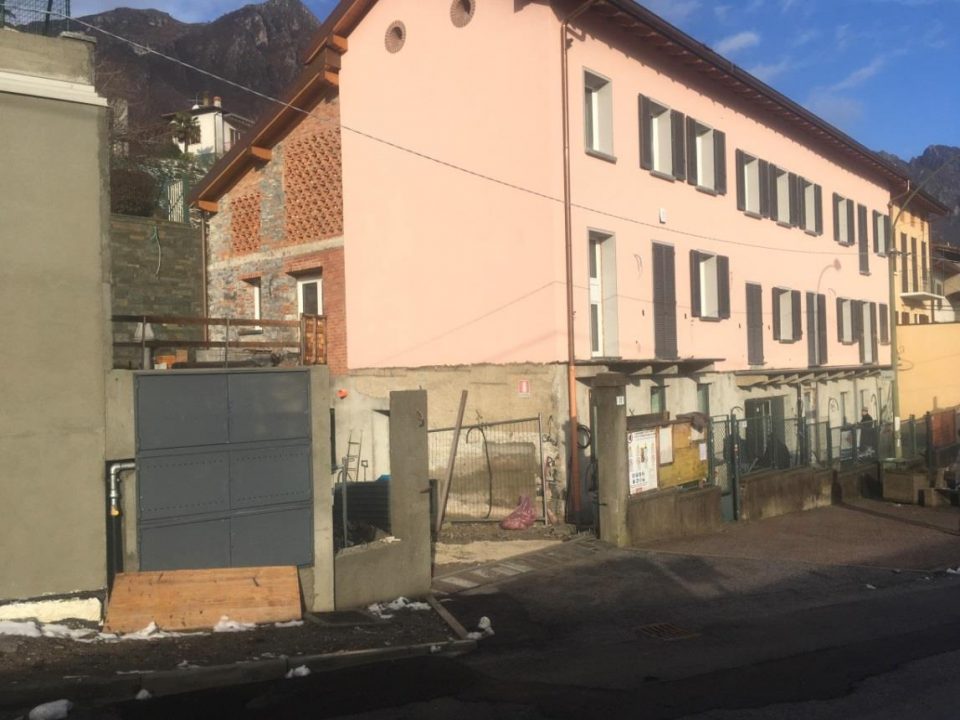
Renovation of a historic building with expansion and creation of a parking lot near Lecco


Dettagli
Fissaggio macchinari industriali
March 11, 2026

Fixing of industrial machinery in a bending and painting plant in Trezzano


Dettagli

© 2024 PROIND SRL - P.IVA: 04084490152 - All Rights Reserved.
Via Fornace Cavallino 13/15 - 20073 Opera (Milano) - Italy

Tel.: +39.02.57602651 - Fax: + 39.02.5760635 - E-mail: info@proind.it

Privacy

    0English
    • Italian
    • English