

Form release – i.e. the removal of formwork – is a crucial moment in any concrete pour. Form release agents ensure that the concrete comes away easily from the formwork, protecting surfaces, reducing operating times and costs, and preserving the integrity of the structure.
In the case of exposed concrete (smooth, aesthetic, unplastered) or precast concrete, the surface finish is crucial: the right form release agent allows you to obtain homogeneous, clean surfaces without defects such as stains, marks, bubbles or colour unevenness.
In addition to the aesthetic aspect, correct formwork release facilitates the cleaning and reuse of formwork, improves its durability and optimises time on site or in prefabrication.

Perfect disarming effect: how to avoid bubbles, stains and adhesions on the concrete surface
February 25, 2026
Sirionet: the professional concrete descaler
February 25, 2026Criteria for choosing disarming oil: what to consider
To select the most suitable oil or release agent for an exposed or precast concrete project, consider the following aspects:
1. Type of formwork:
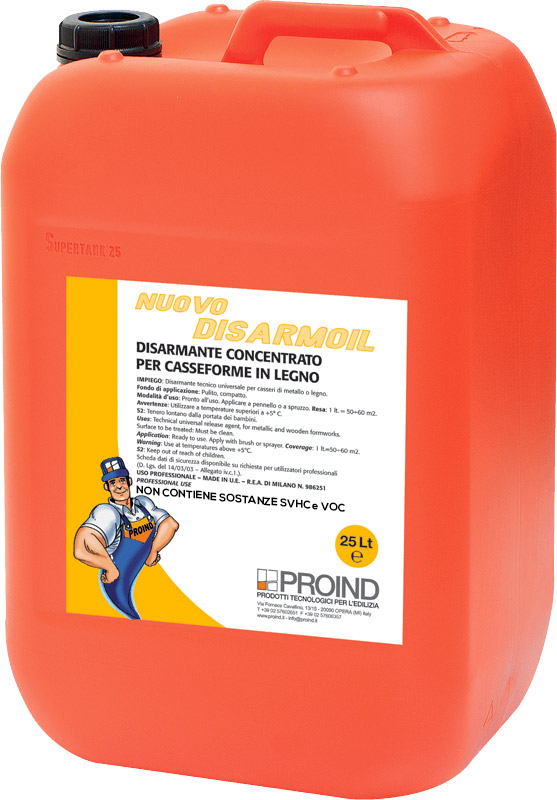
- Wood/plywood (absorbent) : require light, low-viscosity products or chemically active agents such as NUOVO DISARMOIL or ECOFINISH.
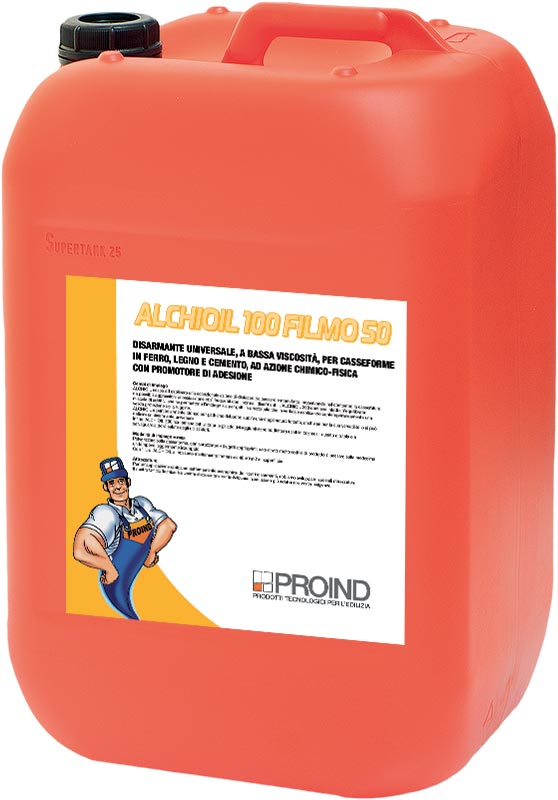
- Steel, metal or plastic (non-absorbent): require thin, uniform films. Mineral or synthetic oils are ideal, such as ALCHIOIL 100 or ALCHIOIL 100 FILMO 50. Alternatively, well-applied vegetable emulsions, such as VEGESFORM ECO BG, can be used.
2. Required surface finish:
For exposed concrete or precast elements with a smooth surface, without plaster, a ‘chemically active’ agent or vegetable/emulsified oil is preferable to ensure fewer bubbles, a compact finish, colour uniformity and no stains.
3. Demoulding methods and times:
- Immediate demoulding: fresh vibrated casting, rapid prefabrication: oils with rapid release properties are required, suitable for quick demoulding. For example, synthetic oils or products designed for ‘immediate release’.
- Delayed demoulding / pre-seasoning / slow-drying prefabricated products: prefer agents with stable consistency, perhaps in emulsion, which remain effective even when left to stand.
4. Environmental compatibility, safety and maintenance:
Vegetable/biodegradable oils/aqueous emulsions are often preferred today due to their lower toxicity, reduced environmental impact and improved safety for operators. They also protect formwork from rust or deterioration, reducing maintenance.
5. Costs and logistics management:
Synthetic or mineral oils tend to be cheaper and more stable. Vegetable/emulsified oils are more expensive and delicate, but offer aesthetic and environmental benefits. For large projects or industrial prefabrication, it may be necessary to consider quantity, storage and agitation.
How to apply a disarming oil correctly: best practices
To achieve the best results in terms of finish and ease of removal:
- Clean the formwork thoroughly before application (free of dust, residues, loose parts).
- Apply a thin, even layer: a glossy but not stagnant film. ‘Very little is better than too much.’
- Avoid accumulation: oil stagnation can cause surface defects, stains and hardening delays.
- Use suitable equipment: oil-resistant sprayer, flat nozzle preferable, adequate pressure.
- If switching from one type of oil to another on reused formwork, completely remove previous residues before reapplying.
The risks of incorrect selection or application
- Inappropriate use of ‘barrier’ oils: can cause surface defects such as air bubbles, porosity, macro- or micro-bubbles, halos or stains.
- Excessive application: risk of delays in hardening, colour unevenness, poor aesthetics and adhesion problems with any subsequent treatments (paints, plasters, etc.).
- Poor environmental compatibility or regulations: some mineral or solvent-based oils may be subject to regulatory restrictions for VOCs or operator safety; vegetable emulsions are preferable.
- Inadequate formwork maintenance: residues of release agent that have not been properly cleaned can compromise subsequent castings.
Proind formwork: added value for prefabrication and exposed concrete
Proind offers a range of release agents designed to meet the various needs of construction sites and prefabrication, with a particular focus on efficiency, surface quality and environmental sustainability.
- With ready-to-use products such as ALCHIOIL 100, it is easy to remove concrete from steel formwork, maintaining the original colour of the concrete and ensuring an excellent ‘exposed finish’. For wood, however, an emulsifiable product such as NUOVO DISARMOIL is preferable.
- The Proind range also offers ‘green’ and efficient solutions that meet modern sustainability and environmental awareness requirements — an increasingly important factor in contemporary construction.
- With the right formwork release agent, the work cycle (casting → formwork removal → formwork cleaning → new casting) is smoother, reducing maintenance and downtime, which are key factors in prefabrication or large-scale projects.

Conclusion and practical recommendations
- First of all, consider the type of formwork, type of concrete and desired finish: if you are looking for an elegant and uniform ‘exposed finish’, choose chemically active release agents or vegetable/emulsified oils; if you are working in standard prefabrication or on a general construction site, a mineral or synthetic oil may be more suitable.
- Apply the oil in a thin, even film using suitable tools, avoiding build-up and stagnation.
- For reused formwork, make sure you clean the surfaces thoroughly before each application.
- Also consider safety, the environment and regulations: choose certified products that are low-impact and safe for operators and the structure.
With the correct choice and application of release oil, it is possible to obtain high-quality exposed concrete, reliable prefabricated elements and durable structures, while optimising processing times and costs.
It is also important to pay attention to the type of cement used: to meet sustainability requirements, many manufacturers now add an increasing amount of additives. However, these additives are not always compatible with release agents and can cause stains, marks or other imperfections on the concrete surface.
Discover Proind's concrete and mortar release agents.
We invite you to discover our range of Proind release agents, designed to offer effective solutions for every casting or prefabrication situation. Each product is designed to facilitate demoulding and improve surface quality, from wooden to metal formwork. Whatever your needs, you will find the ideal release agent to achieve clean, uniform and professional results.
-
Read more
Disarming agent for wooden, iron, and concrete formwork
ALCHIOIL 100 is a ready-to-use synthetic release agent, specially formulated with additives that facilitate demolding.
-
Read more
Disarming for all low-viscosity formwork
ALCHIOIL 100 W is a form release agent containing special additives that facilitate demolding and protect formwork.
-
Read more
Release agent for all formwork with adhesion promoter
ALCHIOIL 100 FILMO 50 is a release agent composed of special additives and an adhesion promoter that allows demoulding for vertical and horizontal castings.
-
Read more
Ready-to-use universal synthetic disarming agent
ALCHIOIL 200 is a ready-to-use synthetic release agent, specially formulated with additives that act as inhibitors.
-
Read more
Ready-to-use universal low-viscosity disarming agent
ALCHIOIL 400 is a ready-to-use release agent, specially formulated with additives that allow for immediate demoulding.
-
Read more
Emulsion-based disarming agent
ECOFINISH is a formulation containing special synthetic oils and biodegradable plant-based additives that produces smooth, bubble-free finishes.
-
Read more
Water-based emulsion paint remover for exposed finishes
ECOFINISH PLUS is a formwork release agent formulated with biodegradable plant-based additives that are safe for humans and the environment.
-
Read more
Pre-emulsified release agent for wooden formwork
EMULSFORM is a latest-generation formwork release agent. The product is composed of special synthetic oils and high-quality emulsifiers.
-
Read more
Concentrated dismoulding agent for wooden formwork
NUOVO DISARMOIL is a degreaser composed of special synthetic oils and high-quality emulsifiers that does not contain SVHC or VOC substances.
-
Read more
Pre-emulsified creamy disarming agent
PRONTOSFORM is a paste-like release agent with excellent adhesion to the walls of vertical formwork, on which it forms a protective film.
-
Read more
Environmentally friendly quick-release disarming device
RAPIDSFORM BIO is an environmentally friendly form release agent that isolates the formwork and reacts chemically with the concrete to create insulation.
-
Read more
Disarming agent for rapid concrete breaking
RAPIDSFORM FL is a release agent formulated for the rapid removal of concrete products from moulds, allowing for easy cleaning of the moulds.